
Two years ago I wrote that AI was changing how search worked for MSPs. I was right about the direction and wrong about some of the specifics, which is a good enough reason to write this again with better numbers.
Here’s the honest answer to the question in the title: yes, but not in the way it was relevant in 2024, and the parts that still work are not the parts most MSPs are spending money on.
What actually changed
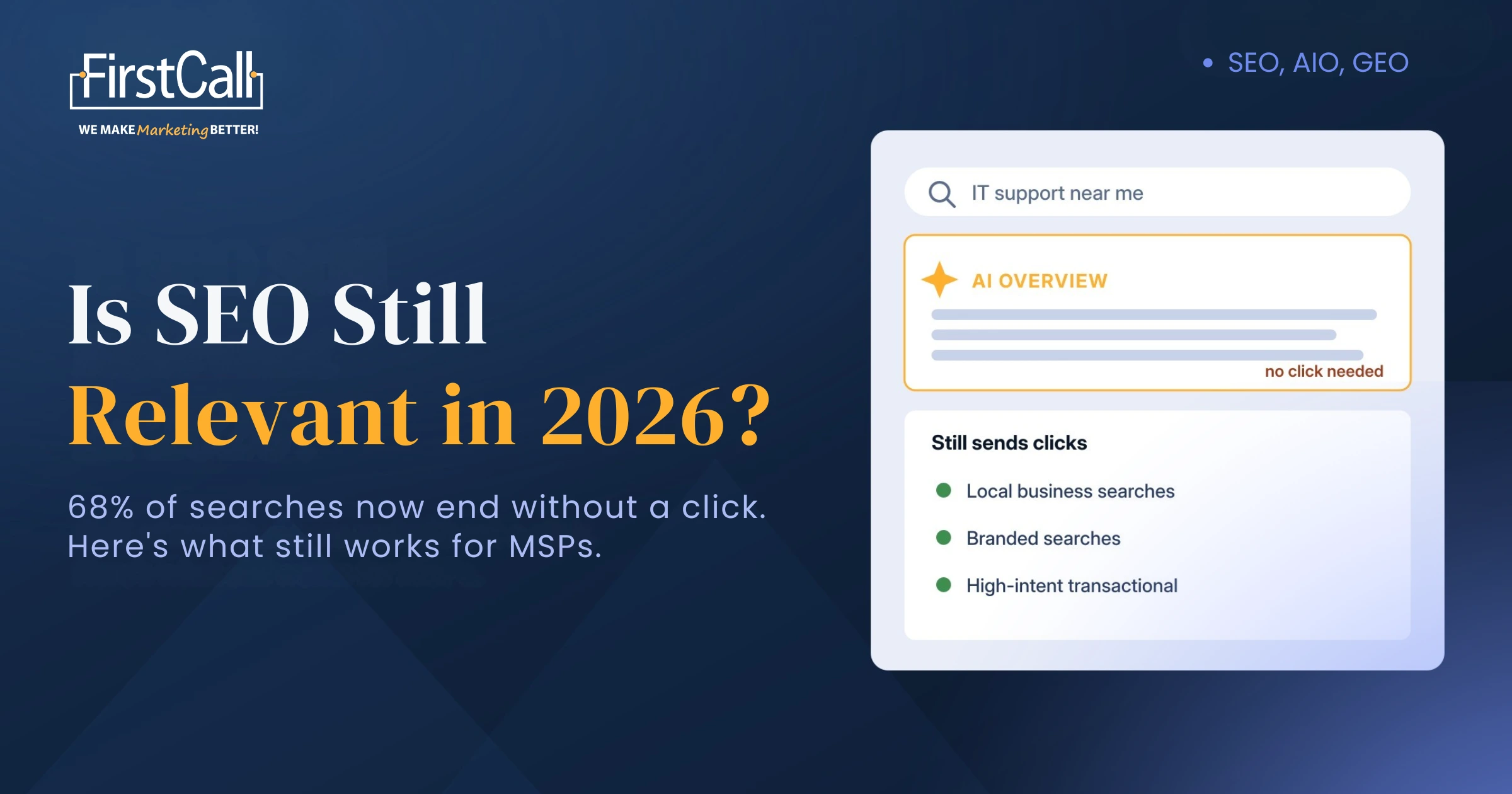
Roughly 68% of Google searches now end without anyone clicking through to a website, according to SparkToro’s June 2026 study using Similarweb data. A decade ago that figure was about 45%. Estimates vary by methodology, some analyses put it closer to 65%, others above 80%, so treat the exact number with some caution, but every serious study points the same direction and the acceleration lines up with the AI Overview rollout.
The practical version for an MSP: someone searches a question your business could answer, Google answers it directly, and nobody visits your site. Your ranking didn’t drop. Your traffic did.
So is SEO dead for MSPs?
No, and the reason why is more useful than the headline. SparkToro’s own analysis notes that certain categories still benefit meaningfully from search: branded searches, local business queries, and high-intent transactional searches. That is a fairly precise description of how people actually look for an MSP.
Nobody searches “what is managed IT” and then signs a contract. They search your company name after a referral. They search for IT support in their city because their server just went down. They search for something specific and urgent, and those are exactly the searches that still send clicks.
What’s dying is informational SEO, the blog post that ranks for a general question and hopes to catch someone early. AI answers those now. What’s still working is the search someone runs when they already have a problem and a budget.
I got the Local SEO call wrong
In 2024 I argued that MSPs should stop prioritizing Local SEO, because Google had pushed the map pack down for IT-related searches and because most clients don’t visit an MSP’s office anyway. The observation about the map pack was accurate at the time. The conclusion I drew from it has not aged well.
Local business queries turn out to be one of the few categories where search still reliably produces clicks in 2026, precisely because they carry intent that AI summaries can’t satisfy. Someone whose network is down does not want a summary of what managed IT services are. They want a provider who is nearby, available, and demonstrably real.
If you deprioritized your Google Business Profile on that advice, that’s worth revisiting.
What to actually do differently now
Get cited, not just ranked. When AI Overviews or ChatGPT answer a question about managed IT, they build that answer from sources. Being one of those sources is now its own goal, separate from ranking. Clear, specific, well-structured content that directly answers real questions gets pulled into those answers. Vague content doesn’t. I went deeper on the mechanics of this in how to keep up with SEO and AI search, which covers what actually earns a citation.
Be specific enough to be quotable. This is the part that connects to what I wrote in 2024 and still holds: the MSP space is full of identical copy. “We provide comprehensive managed IT solutions” is not something an AI can meaningfully cite, because it says nothing. “We support dental practices in Bozeman running Dentrix” is citable, because it contains actual information.
Keep the technical basics. Title tags, semantic markup, internal linking, a clean sitemap. These matter as much as they did, arguably more, because they’re how machines understand what your page is about. Structured data and clear question-and-answer formatting help AI systems parse your content correctly.
Watch different numbers. If you’re measuring SEO purely by traffic, you’ll conclude it stopped working. Track branded search volume, whether you appear in AI answers for questions in your niche, and where actual inquiries say they found you. Traffic is a worse proxy for visibility than it used to be.
What about ranking for “IT support near me”?
Still worth it, and still competitive. Local and high-intent queries are where clicks still live, which means the competition for them has concentrated rather than eased. A complete, current Google Business Profile with recent reviews is doing more work now than a blog post targeting a general keyword.
The MSPs I see winning search in 2026 aren’t the ones publishing the most content. They’re the ones who are specific about who they serve, easy for both people and machines to understand, and consistently present in the small number of searches that still convert.
Where to start
If you’re not sure whether any of this is currently true of your site, that’s the actual first question, not whether SEO is dead.
Our free MarketingStack Challenge looks at where you stand across search, content, and profiles, and tells you plainly which of these gaps applies to you.
If you want the deeper version, our Marketing Strategizer includes AI search visibility as one of its twelve checkpoints, which was not something anyone was auditing two years ago.
Quick answers
Is SEO still worth investing in for an MSP in 2026? Yes, but narrowly. Local, branded, and high-intent transactional searches still send clicks and still convert. General informational content that used to attract early-stage traffic is largely being absorbed by AI answers.
What is the difference between SEO and GEO? SEO targets your position in a ranked list of links. GEO, generative engine optimization, targets being cited inside an AI-generated answer. They overlap heavily in practice, since the same clarity and structure that helps you rank also helps you get quoted, but the goal is different.
Should MSPs still bother with Google Business Profile? Yes, more than ever. Local business queries are one of the few search categories that reliably still produce clicks in 2026, and your profile is often the deciding factor in which nearby provider someone calls.