
Leads come in. Deals don’t close. Somewhere in between, they leak. Your website gets traffic, and a proposal went out three weeks ago that nobody has answered.
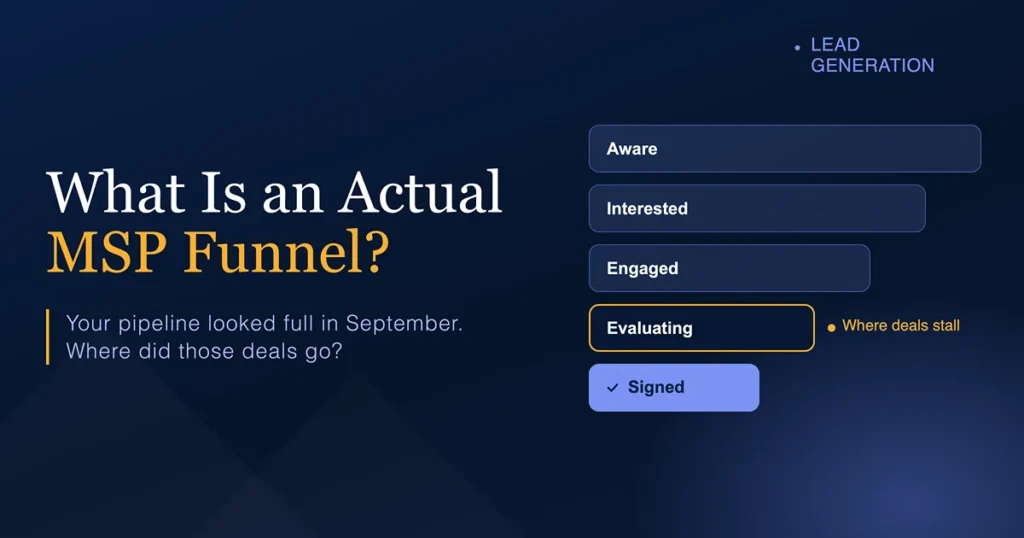
The quick diagnosis: if your MSP isn’t getting leads, or isn’t closing the ones it gets, the funnel is breaking in one of five places: prospects can’t find you, they find you and can’t tell you apart, they’re interested and can’t easily start a conversation, your referrals and outreach run on luck, or deals stall somewhere between discovery call and signed agreement. To find yours, walk through your own pipeline the way a prospect would, one stage at a time, and note where they’d stop.
Our parent company is an MSP, so these are the questions we ask about our own pipeline too.
Why is my MSP not getting leads?
MSP funnels wear thin slowly, usually in the handoffs. A few patterns show up again and again:
- Marketing runs on spare time. ConnectWise’s 2026 MSP Marketing Report found 57% of MSPs have zero or limited marketing experience in-house, and only 18% have more than one person dedicated to it. When the help desk gets busy, marketing is the first thing to slide.
- One channel carries everything. Usually that’s referrals. 72% of MSPs call referrals a key driver of business, yet only 43% have a formal referral program.
- The budget is too thin to test anything. Half of MSPs spend under $10,000 a year on marketing, so every channel gets a little and none gets enough.
- Nobody can see the whole pipeline. 14% of MSPs aren’t sure how to measure whether their marketing works. If you can’t say where your last five clients came from, you can’t say where the funnel leaks.
Sound familiar? All of that is fixable, and the first step toward a predictable pipeline is finding which stage is leaking.
Stage 1: Can prospects find you?
Open a private browser window and search the way a business owner in your area would: “managed IT services” plus your city, “IT support for dental offices,” “co-managed IT,” “MSP near me.” Then ask the same question in ChatGPT or Google’s AI Mode. Note who gets named.
Then check the basics:
- Is your Google Business Profile complete, with recent reviews and replies?
- Does your website have a page for each service and each industry you want to win?
- Do you or your team post on LinkedIn often enough that a prospect checking you out sees an MSP that’s active?
- Would an AI tool summarizing your site be able to say what you do and who for?
If this stage is broken, your site sees little organic traffic, and most new business comes from people who already knew your name.
Stage 2: Can they tell you apart?
Read your homepage headline next to three competitors’. If you could swap the logos without anyone noticing, a prospect can’t tell you apart either. “24/7 proactive support” and “your trusted IT partner” appear on a lot of MSP sites.
A page written for a 40-person accounting firm in tax season beats a page written for “businesses of all sizes” almost every time an accounting firm reads it.
If this stage is broken, you get traffic and very few discovery calls, or calls that open with “So what makes you different?”
Stage 3: Is it easy to start a conversation?
On your phone, try to book a call with yourself and count the clicks. Look for a calendar link, a phone number that dials when tapped, a form short enough to finish on a phone and a clear idea of what happens after someone hits submit.
If you run paid ads, this is where most of the spend leaks: the clicks come, and they land on a page with no clear next step. Then look at what you offer people who aren’t ready for a call. A checklist or a short assessment gives them a reason to hand over an email address now and hear from you again later.
If this stage is broken, your contact page gets visits and few submissions, and the leads you do get are already shopping on price.
Stage 4: Do referrals and outreach run on a system?
Among MSPs with a referral program, one in three say referrals bring in more than half their revenue (ConnectWise, 2026). That’s exactly why they shouldn’t run on luck.
Ask yourself:
- Do happy clients get asked for an introduction at a set moment, like after a QBR or a smooth project?
- Is there any outreach at all when referrals go quiet for a quarter?
If this stage is broken, your pipeline swings with the referral calendar. Good quarters feel great. Slow quarters arrive with nothing behind them.
Stage 5: Do deals stall after the first call?
MSP sales cycles are long. A discovery call that goes well can still go quiet for weeks while the prospect checks with their CFO and their current provider’s contract terms.
Pull your last ten proposals. How many closed, and how many simply went silent? A single “just checking in” email doesn’t count as follow-up.
If this stage is broken, you hold plenty of good discovery calls and win fewer than you should.
Which stage should you fix first to generate more MSP leads?
Match what you’re seeing to the most likely leak.
| What you’re seeing | Where it’s probably broken |
| Little organic traffic, new business only from people who know you | Stage 1: visibility |
| Traffic, but few discovery calls | Stage 2: positioning |
| Contact page visits, few form fills | Stage 3: lead capture |
| Ad clicks, but no calls | Stage 3: lead capture |
| Pipeline swings quarter to quarter | Stage 4: referrals and outreach |
| Good calls, proposals going quiet | Stage 5: sales process |
If more than one stage looks shaky, start with the one closest to a signed agreement. Following up on proposals you’ve already sent is usually the cheapest fix available.
Not sure which row is yours? The MarketingStack Challenge can help you find it, and there’s more on it below.
When should you bring someone in?
The walk-through above takes an afternoon, and most owners find at least one fix they can make this week. It gets harder when the leak spans several stages, or when nobody on the team has the hours to keep marketing moving while the help desk is busy.
Our free MarketingStack Challenge is a 30-minute look at what’s visible right away, with a written report of what to fix first.
Frequently asked questions
How do you get leads for an MSP? Start where your buyers already look: a complete Google Business Profile, a website page for each service and industry you want to win, referrals with a system behind them and an active LinkedIn presence. Then make sure every lead gets a fast reply and a real follow-up, so the leads you earn turn into calls.
How do MSP companies generate more leads? Find the stage where prospects drop out and fix that before adding a new channel. Sending more traffic into a leaking funnel mostly buys more leaks. For a picture of what a working MSP funnel looks like end to end, read “What Is an Actual MSP Funnel?“
Why are my MSP ads getting clicks but no calls? Usually the click lands on a page with no clear next step, like a general services page with a long form, and nobody follows up quickly with the people who do fill it in. Fix where the click lands and who calls back before you raise the ad budget.
Should MSPs rely on referrals? Referrals are worth protecting, and they work best with a system behind them. Relying on them alone leaves your pipeline exposed whenever they slow down.
How often should an MSP review its funnel? At least twice a year, and whenever something big changes, like a new vertical or a website rebuild.
Want to know exactly where your pipeline leaks? Take the MarketingStack Challenge. It’s a free 30-minute call, and you’ll leave knowing which stage to fix first.