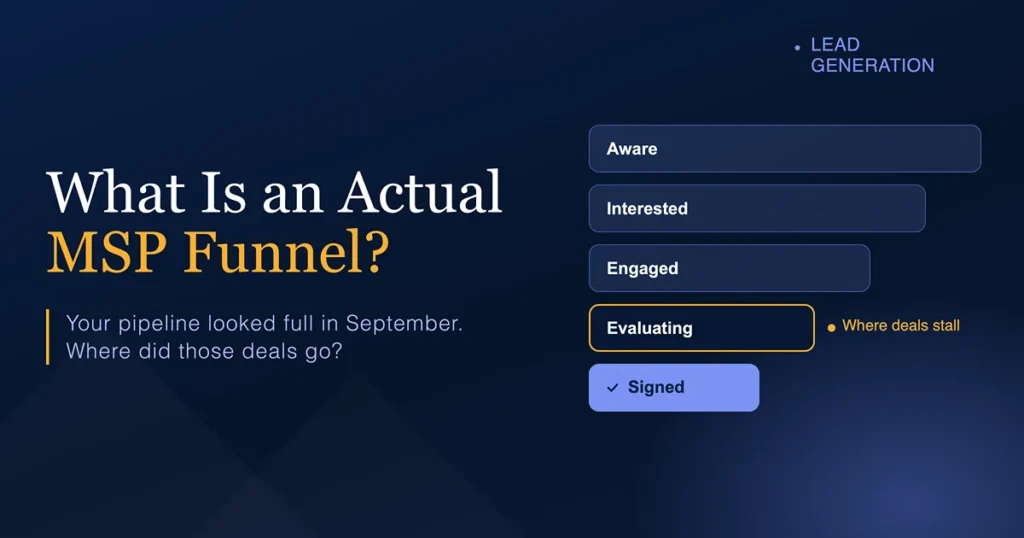

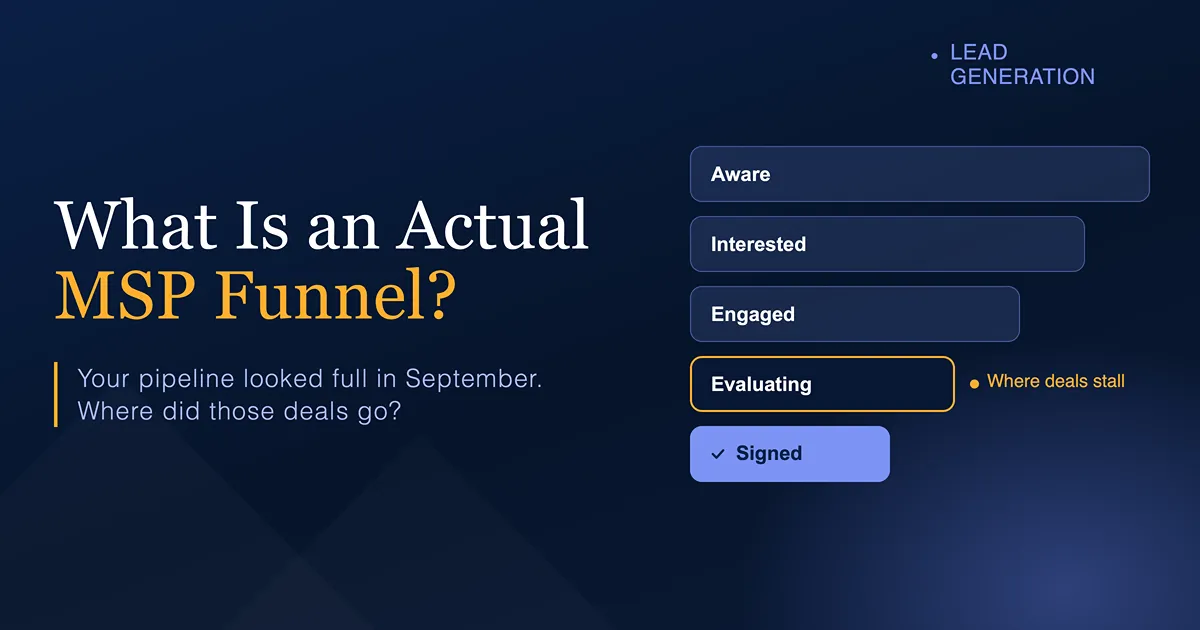
Your pipeline looked full in September. Where did those deals go?
An actual MSP funnel is every step between a business noticing your name and signing your MSA. Every stage has a clear next step and someone who owns it. Most MSPs have the pieces: a website, a LinkedIn page, a few referral partners and a CRM someone updates when they remember. MSP sales funnel optimization starts with joining those pieces up, so you can see where deals slow down and fix that stage first. That’s how a pipeline gets predictable.
We market an MSP of our own, and these are the numbers we watch in its pipeline every month.
What is an MSP sales funnel?
An MSP sales funnel is the series of steps a prospect moves through before they trust you with their network. It covers how they find you, how they compare you, how they raise a hand and how a discovery call turns into a signed agreement.
MSP funnels behave differently from most B2B funnels in a few ways:
- The cycle is long. Plenty of prospects are locked into a contract with their current provider, so the real buying window opens months before their renewal date.
- More than one person decides. The owner usually signs, and the office manager often has a strong say.
- Trust carries the sale. Handing over your network means handing over your business, so proof matters more than price.
- Something has to change first. A bad outage, a new compliance requirement, a growth spurt or a run of slow tickets usually starts the search.
That’s why a funnel copied from a SaaS playbook rarely fits. MSP buyers move slowly, then all at once.
What are the stages of an actual MSP funnel?
Here’s how the stages line up for a typical MSP, with what needs to be in place and the one number worth watching at each.
| Stage | What the buyer is doing | What you need in place | Number to watch |
| Aware | Noticing you through search, LinkedIn, a referral or an event | Pages that answer their questions, an up-to-date Google Business Profile | Visits from your area and target industries |
| Interested | Comparing you with two or three other MSPs | Service pages, industry pages, case studies and reviews | Return visits and content downloads |
| Engaged | Raising a hand | A low-pressure next step and a short form or calendar link | Calls and inquiries booked |
| Evaluating | Discovery call, network assessment, proposal | A follow-up plan and a proposal deadline | Days from discovery to proposal |
| Signed | Agreeing to the MSA | Onboarding, then a referral or review ask | Close rate and time to close |
Referrals, SEO, ads and events are lead sources. They feed the top of the funnel. The funnel is everything that happens after someone arrives, and that’s where most MSP pipelines leak.
What does a working MSP funnel look like?
Picture a 30-person accounting firm whose office manager is tired of slow tickets from their current provider. In June she searches for managed IT for accounting firms and finds your industry page. She downloads a checklist and starts getting a short email series from you.
In September she books a call. Your team notes that their contract renews in January and sends a proposal within a week of the network assessment. A follow-up lands before the partners’ next meeting, with a case study from another accounting firm. They sign in early December, and a couple of months into onboarding you ask for a referral.
Every stage had a next step, and nobody had to remember to send it.
Why do MSP pipelines look full, then empty out?
Usually the deals stalled somewhere between the discovery call and the proposal, and nobody noticed until the quarter closed.
A few patterns come up again and again:
- Deals parked on a renewal date. The prospect liked you, then said “our contract runs until March.” Nobody wrote the date down.
- Follow-up that lives in the owner’s calendar. When a client’s server goes down, the proposal waits.
- No next step for people who aren’t ready. A prospect who’s nine months from switching gets the same “let us know when you’re ready” as one who’s ready now.
- No owner for the middle of the funnel. Marketing hands over the lead, sales assumes marketing is still nurturing it, and the lead sits.
Sound familiar? All of that is fixable.
How do you optimize an MSP sales funnel for higher conversions?
These MSP sales funnel optimization tips work in any order, though the first one makes the rest easier to judge.
- Track one number per stage. Start with the five numbers in the table above, even in a spreadsheet. You can’t fix a stage you can’t see.
- Start where the drop is steepest. If plenty of people book calls and few get proposals, the problem is in the middle, and more traffic won’t help.
- Write down every renewal date. Then put a reminder 90 days before it and reach out with something useful.
- Give not-ready prospects a reason to stay in touch. A checklist or a quarterly check-in keeps you in the conversation until the window opens.
- Reply fast, then set a deadline. Research published in Harvard Business Review found that most companies are not responding to online leads nearly fast enough. Answer new inquiries the same day, and decide how many days the team has after discovery to send a proposal.
- Build proof for the buyers you want. A case study from a dental group will do more for the next dental group than any amount of general copy.
Each of these works best with one person who owns the stage and checks the numbers every month.
Where should you start?
If you’d like a second opinion on which stage is costing you the most deals, take the MarketingStack Challenge. It’s a free 30-minute call where we look at your pipeline with you, and you’ll leave with a clear read on what to fix first.
For a full benchmark of every channel against the MSPs you compete with, the MarketingStack Strategizer is the deeper option.
Not ready for a call? Browse our free resources instead.
Frequently asked questions
What is MSP sales funnel optimization? It’s the work of improving how many prospects move from one stage of your funnel to the next, from first visit to signed agreement. In practice that means measuring each stage and fixing the biggest drop before spending more on new leads.
How many stages should an MSP funnel have? Five is enough for most MSPs: aware, interested, engaged, evaluating and signed. More stages make the funnel harder to track without making it more useful.
Do small MSPs need a sales funnel? Yes, even if it lives in a spreadsheet. A small MSP loses proportionally more when one good prospect slips through, so knowing where deals stall matters more at that size.
What should an MSP track first? Start with the days from discovery call to proposal, and your close rate on proposals. Those two numbers show whether the middle of your funnel is working.
Want to know which stage is costing you deals? Take the MarketingStack Challenge. It’s a free 30-minute call, and you’ll leave knowing where to start.