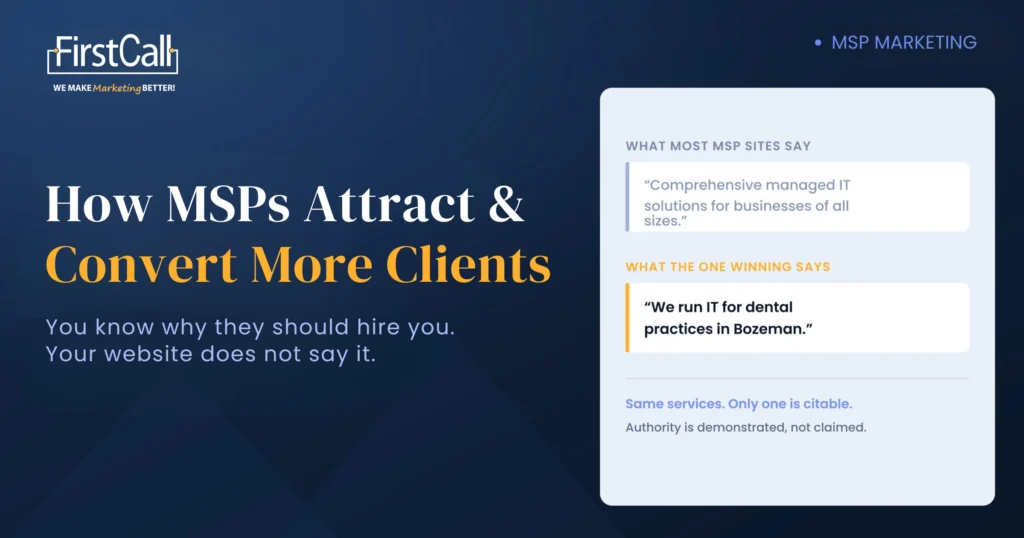

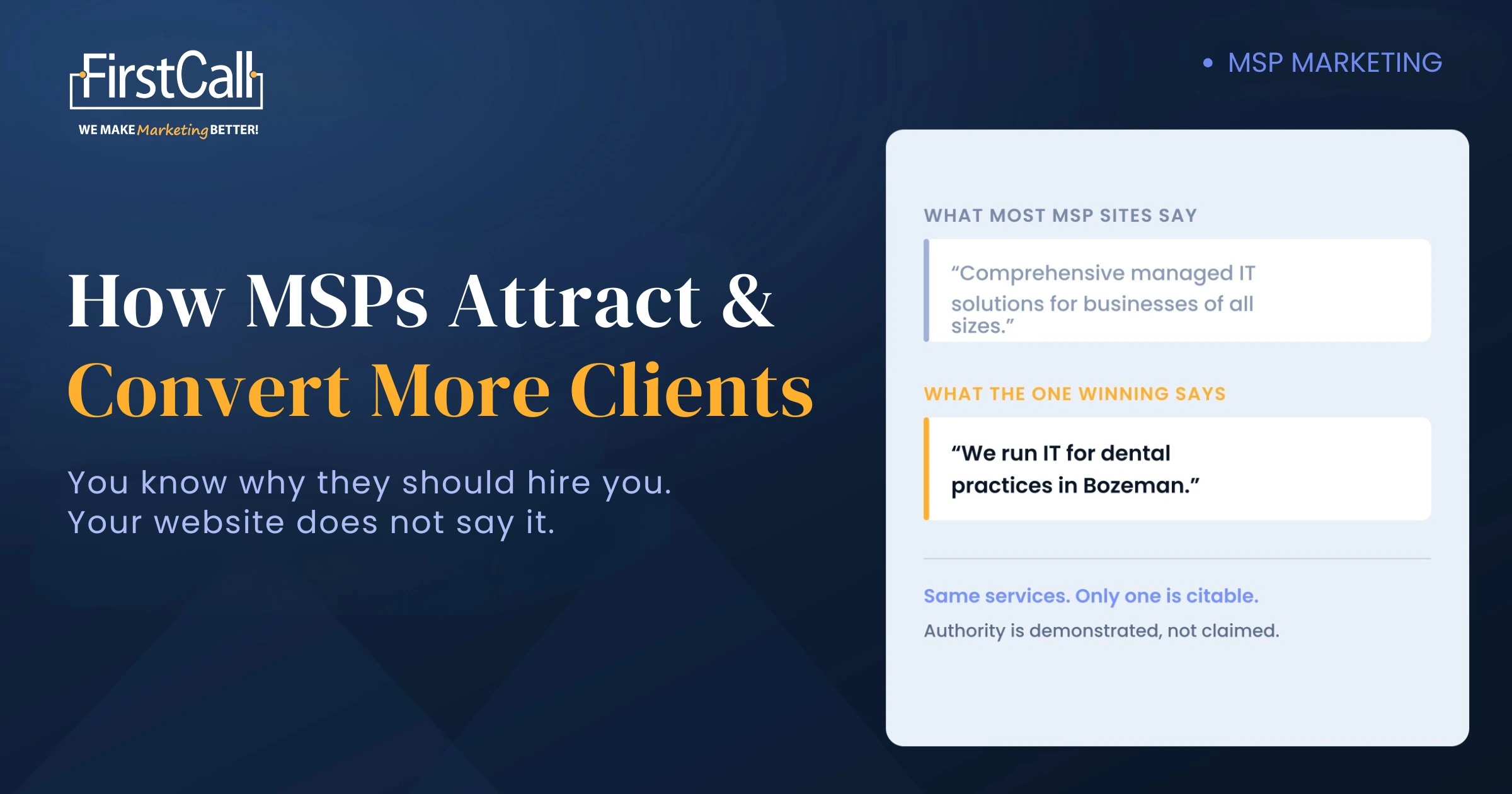
Every MSP owner I talk to knows exactly why a prospect should hire them. They’ll tell you in about ninety seconds, unprompted, and it’s usually genuinely good. Then I go look at their website and find three paragraphs about being a trusted technology partner.
That gap is the whole problem. You can explain your value beautifully in a room, and I’m sure you do. The trouble is that most buying decisions now happen well before you ever get in the room.
Why authority does the selling before you show up
When someone needs a managed IT provider, they don’t call three MSPs and compare. They look you up. They read your site, skim your reviews, maybe ask an AI assistant who’s good in their area. By the time they contact you, they’ve already decided whether you’re worth a conversation.
Authority is what makes that decision go your way, and I mean demonstrated authority rather than claimed. A site that says “we’re the best” gives a stranger nothing to verify. A site that explains how you handle a ransomware recovery, or what you do differently for clinics running legacy practice software, gives them something to believe.
Think about how you evaluate vendors yourself. Do you take their word for it? Of course not. You read what they’ve written, check whether it sounds like someone who’s actually done the work, and quietly form a judgment. Your prospects are doing precisely that to you right now, probably while you’re reading this.
The mistake I see most: writing for people who already agree with you
Plenty of MSPs skip content because they assume their clients already know the basics. Why write about phishing when every business owner on the planet has sat through a phishing training?
Because they aren’t reading it to learn about phishing. They’re reading it to find out whether you, specifically, know about phishing. The subject is almost beside the point. What they’re really assessing is whether you sound like someone who handles this every week, or someone who skimmed a vendor blog last Tuesday and hit publish.
That distinction shows up in specifics. “Regular backups are essential” tells a reader nothing. “We test restores quarterly because a backup nobody has restored is a theory, not a backup” tells them you’ve been through it.
What makes content read as credible
Depth over breadth does most of the work. One article that goes properly deep on a problem your clients have beats ten that skim the surface of everything.
Original opinions help more than they should, mostly because so few MSPs risk having one. If you think co-managed IT is oversold for businesses under fifty seats, say so and explain why. Someone who agrees will trust you on the spot. Someone who disagrees will at least remember your name, which is more than “5 Tips for Better Cybersecurity” has ever done for anyone.
Real examples carry the most weight of all, and I don’t mean testimonials, which every MSP on earth already has three of. I mean the actual shape of a problem and how you solved it. Anonymize the client if you need to. The details are what make it credible.
And answer real questions. The ones prospects ask on discovery calls are the ones they’re typing into Google and into AI assistants beforehand.
This matters more than it did two years ago
When someone asks an AI assistant to recommend an MSP in their area, the answer gets assembled from whatever sources the model can understand and trust. Specific, well-structured content that clearly answers a real question is what gets pulled into those answers. Vague content isn’t cited, because there’s nothing in it to cite.
That means the same writing that builds authority with human readers now decides whether you appear in AI answers at all. Those used to be two separate jobs. They’ve collapsed into one, which I’d call the only genuinely good news in search this decade, since it halves the work. I dug into the mechanics in whether SEO is still relevant in 2026.
Where to start
You don’t need a content calendar. You don’t need a publishing schedule you’ll quietly abandon in six weeks. You need to write down what you already say out loud, every week, for free, on the phone.
The next time you finish a discovery call, note the questions you were asked. Those are your first five articles. You already know the answers, you just gave them verbally. Getting them onto a page is transcription more than authorship.
From there, three things compound faster than anything else. Write in depth about the two or three problems your best clients hired you to solve. Turn your recent wins into short, specific case studies with real numbers where you can share them. And make sure your service pages say who you serve, not just what you sell, because “comprehensive IT solutions for businesses of all sizes” is functionally invisible to both a buyer and an AI.
None of that requires a marketing team. It requires deciding that the things you already know are worth writing down, which is a harder sell than it sounds, because expertise you use daily stops feeling like expertise.
When it’s worth bringing someone in
If you’ve been publishing consistently and it isn’t converting, the problem usually isn’t your writing. It’s structure, whether the content is findable, whether it’s organized in a way search engines and AI systems can parse, whether the path from article to inquiry exists at all. I covered how that fits alongside everything else in how to pick the right marketing fix for your MSP.
That’s the point where an outside look earns its cost. Our Marketing Strategizer goes through exactly that, what you’re publishing, how it’s structured, and whether any of it is doing measurable work. If you’d rather start with something free, the MarketingStack Challenge will tell you which of these gaps applies to you before you commit to anything.
Our Marketing Strategizer goes through exactly that, what you’re publishing, how it’s structured, and whether any of it is doing measurable work.
If you’d rather start with something free, the MarketingStack Challenge will tell you which of these gaps applies to you before you commit to anything.
Quick answers
How much content does an MSP actually need to build authority? Less than most people assume, but deeper than most people write. Five genuinely useful articles that answer real client questions outperform fifty generic posts, both with human readers and with AI systems deciding who to cite.
What kind of content converts best for MSPs? Content that answers the specific questions prospects ask on discovery calls, and case studies with real detail about a problem you solved. Both give a stranger something concrete to judge you on rather than a claim they have to take on faith.
Do I need to write it myself? Your expertise does. The words don’t necessarily. Plenty of MSPs record themselves answering a question and have someone shape it into an article, which keeps the substance yours while removing the part most owners never get around to.